You applied, and instead of a call you got a link. Record yourself answering questions, no human on the other end. It feels strange, and a little cold. Talking to a camera in an empty room is nothing like sitting across from a person, and most people fumble the first time simply because nobody told them what to expect.
Here is what these interviews actually are, and how to walk in ready.
What you're actually being asked to do
There are two common types. In a one-way video interview, you read a question on screen, then record your answer within a time limit. There is no one to react to. In an AI-led interview, a system may transcribe what you say, or ask follow-ups. Both are usually a first filter before a real person ever sees you.
That word 'filter' matters. This stage is not where you win the job. It is where you avoid being cut. So the goal is to come across clearly, calmly and like a real human, not to perform.
Sort your setup before anything else
In Cairo and Giza, the two things that sink people are the internet and the noise. Fix both before you touch the questions.
- Test your connection. If your home Wi-Fi drops, record from a spot with a stronger signal, or use mobile data as a backup. Don't do this during peak evening hours if your line struggles then.
- Have a plan for the power. If your area has cuts, know your schedule and pick a time that avoids them. Charge your laptop and phone fully the night before.
- Kill the background noise. Street traffic, the microbus horns, family in the next room. Close the window, tell people at home you need twenty quiet minutes, and shut the door.
- Face a window or a lamp, not with the light behind you. Backlight turns your face into a shadow.
- Prop the camera at eye level. A stack of books under the laptop works. Nobody wants to interview your ceiling.
Look into the lens, not at yourself
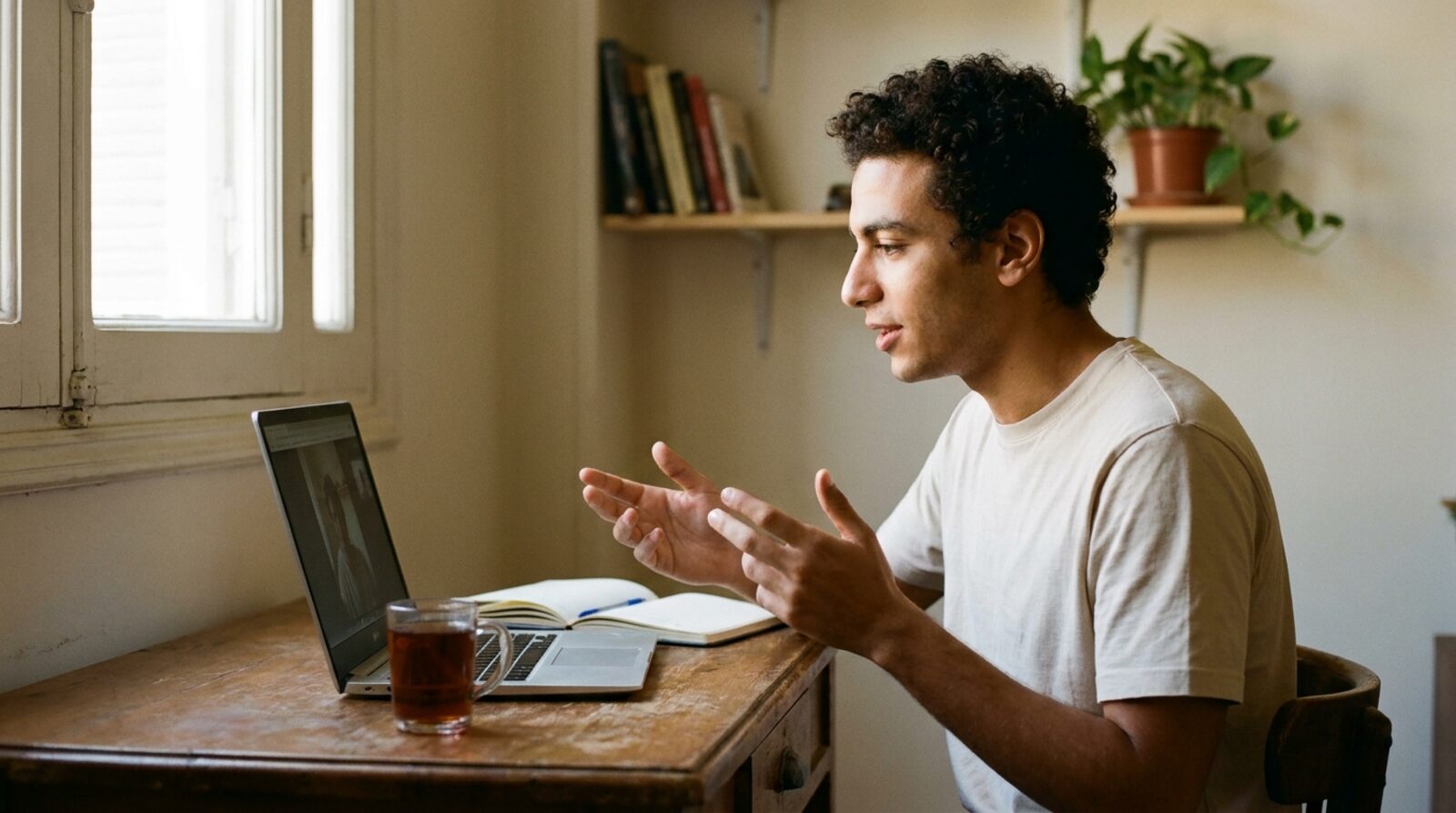
This is the hardest habit to build. On camera, eye contact means looking at the little lens, not at your own face on the screen. It feels unnatural, but to the viewer it reads as confident and honest. Do a couple of practice recordings and watch them back. You will catch yourself staring down at your reflection, and you'll fix it fast once you see it.
Prepare answers, not scripts
You will likely get the standard openers: tell us about yourself, why this role, a time you solved a problem, why you left your last job. Have the shape of each answer ready. Do not memorise it word for word. Memorised answers sound memorised, and if you lose your place with a timer running, you panic.
For the 'tell us about yourself' question, keep it to your last two or three years of work, what you're good at, and why this job fits. Ninety seconds. Not your life story.
For anything asking about a real situation, use a simple structure: what the situation was, what you did, what happened. Concrete beats vague every time. 'I cut our monthly reporting time by half a day by cleaning up the spreadsheet' lands. 'I am a hardworking team player' does not.
The timer is your friend, use it
Most one-way interviews give you thirty seconds to read and think, then one to three minutes to answer. Some let you re-record once, many do not. Read the instructions on the screen before you start, so you know which it is.
- Read the whole question. Don't start talking the second the timer appears.
- Take a breath. Say your first sentence slowly. This buys your brain time to organise.
- Make your main point early, then support it. If you run out of time, at least the key thing was said.
- Stop when you're done. Don't ramble to fill the clock. A tight ninety-second answer beats a shapeless three-minute one.
If English is your second language
Plenty of these interviews are in English, and you may be applying in your second language. Speak a touch slower than you think you need to. Clear beats fast. Short sentences are easier to say well and easier to understand. If you stumble on a word, don't apologise and spiral, just carry on. The person reviewing you cares whether you can do the job, not whether your grammar is perfect. If the role is genuinely in Arabic, answer in Arabic unless told otherwise.
Dress and time it like the real thing
Wear what you'd wear to the office you're applying to. For most accounting, admin, sales and corporate roles here, that's smart and simple. A collared shirt reads well on camera. Avoid busy patterns, they shimmer on video.
On timing: if a deadline falls in Ramadan, don't leave your recording to just before iftar when you're tired and your energy is low. Record earlier in the day when your voice is fresh. And don't wait until the last hour of a submission window. If your internet drops then, you're finished.
A quick word on the 'AI' part
You may worry a machine is judging you unfairly. Speak naturally and clearly, and you help both the system and the human who reviews shortlisted answers later. Don't try to game it with keywords, it sounds robotic and a person will see it. There's usually a human at the next stage, so talk to that person.
Do this today
Record yourself on your phone answering 'tell me about yourself' in ninety seconds. Watch it back once. You'll spot the fidgeting, the 'ums', the moment your eyes drift down. Do it twice more. That single half hour will change how the real one goes.